Nano-Enabled Blue Economy | Case Study
Ocean-scale opportunities emerge from nanoscale processes

Info
- Researcher
- Professor Navid B. SalehCivil, Architectural and Environmental EngineeringUniversity of Texas, Austin
- Art Direction & Visual Design
- Asif Hossain
- Year
- 2026
Project Overview & Context
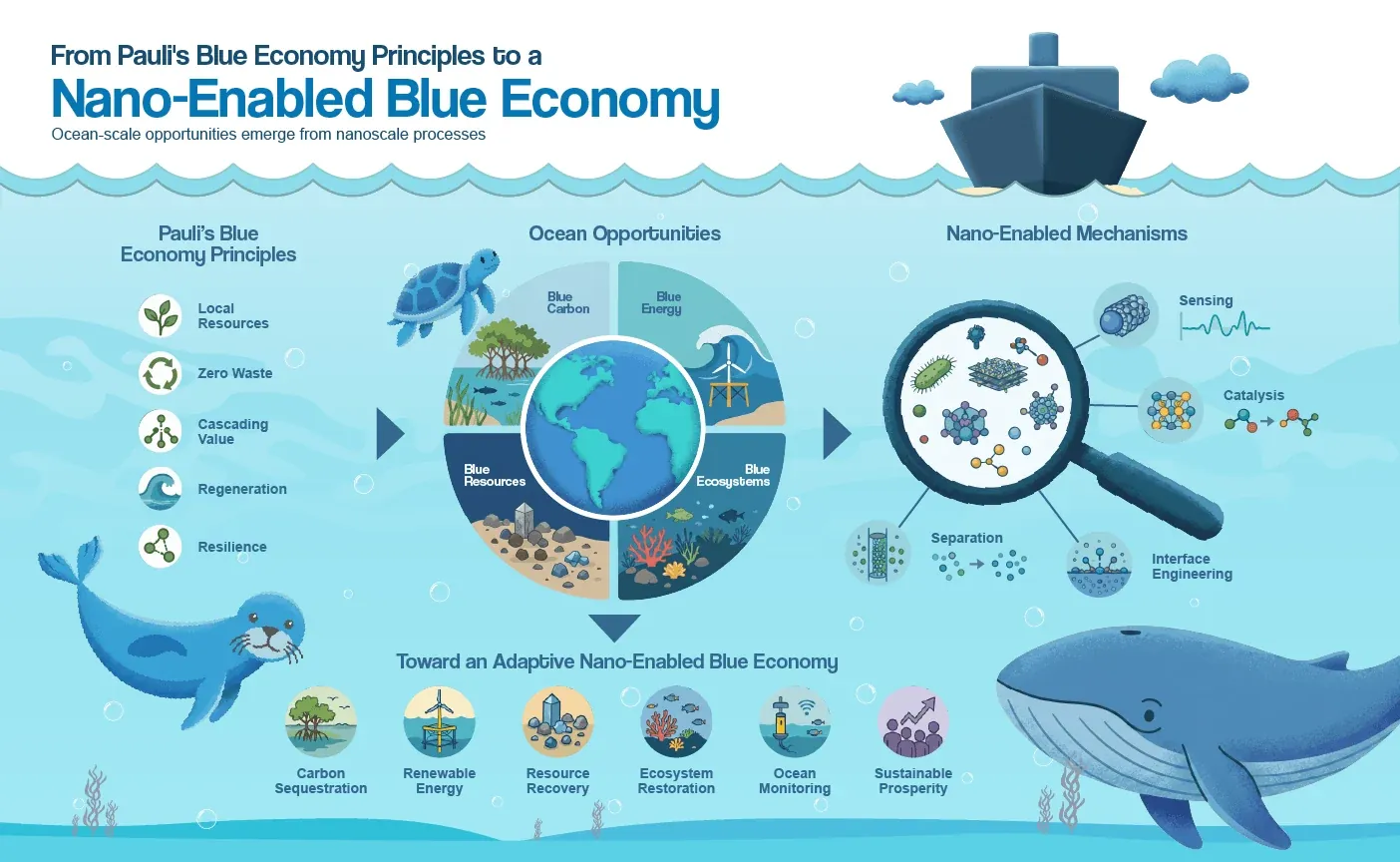
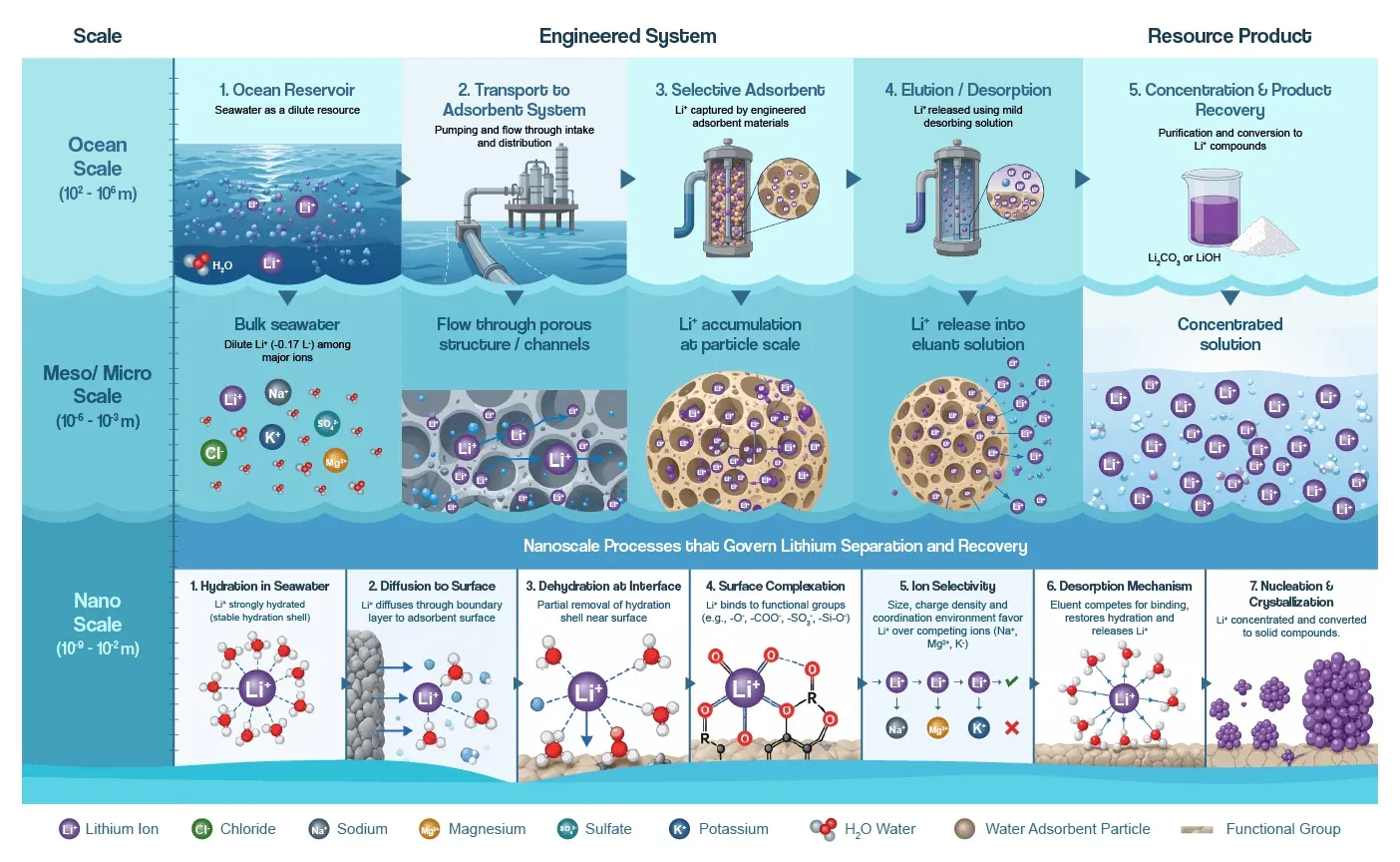
The concept of a "Blue Economy" envisions sustainable, zero-waste utilization of ocean resources. In collaboration with Prof. Navid B. Saleh, this two-part infographic series visualizes how macro-scale ocean opportunities—like renewable energy and resource recovery—are fundamentally driven by nanoscale engineering. The series moves from broad theoretical principles to a highly specific engineered use case: extracting lithium from seawater.
Challenge
- Connecting Theory to Mechanism: Translating Pauli's abstract Blue Economy principles into tangible, nano-enabled ocean mechanisms (like catalysis and separation) without losing the big-picture ecological context.
- Navigating Extreme Physical Scales: Visually mapping a complex engineered lithium extraction system across three vastly different dimensions: the macro Ocean Scale (10² – 10⁵ m), the Meso/Micro Scale (10⁻⁶ – 10⁻³ m), and the fundamental Nano Scale (10⁻⁹ – 10⁻² m).
Target Audience & Goals
Designed for environmental engineers, policymakers, and scientific grant reviewers. The core goal is to quickly demonstrate how nanoscale material science directly unlocks planetary-scale sustainability goals, using lithium recovery as a concrete, step-by-step blueprint.
Design System
- Immersive Aquatic Palette: We anchored the visual identity in a cohesive spectrum of ocean blues, using deep navy to represent the vast ocean reservoir and lighter aqua/teal tones to illuminate the molecular and nanoscale environments.
- Iconic Ecology vs. Technical Geometry: Used approachable, stylized illustrations for the macro-ecology (whales, turtles, cargo ships) to set a welcoming tone. We then transitioned to rigorous, flat vector geometry with specific color-coding (purple for Lithium, green for Chloride, etc.) for the molecular mechanisms like hydration shells and surface complexation.
- Scale-Driven Grids: Employed strict horizontal banding in the technical diagrams to clearly delineate physical scales (Ocean, Meso/Micro, Nano) while maintaining a left-to-right chronological flow of the engineered extraction process.